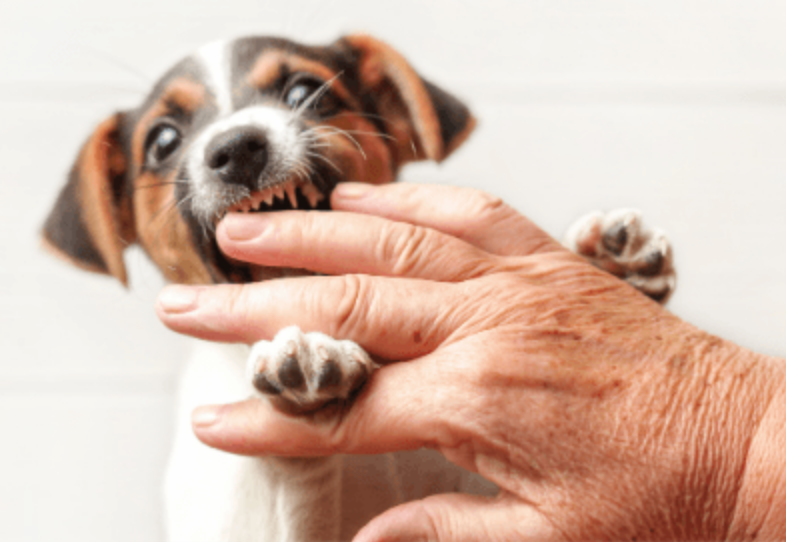
How to Stop Your Puppy Nipping and Biting
You thought you were getting a sweet cuddly puppy but the reality is a fistful of bite marks and a torn trouser leg. This wasn’t what you imagined.
Puppy bite inhibition training is hard work, but without it you will end up with a much bigger dog who has a much stronger bite, so it’s important to nip it in the bud, pardon the pun, even if it doesn’t hurt.
The golden rule is NO TEETH ON FLESH. EVER.
Why is my puppy biting?
Biting is a normal behaviour for all puppies. It’s how they discover the world. They explore with their mouths. Be prepared- they might continue chewing and biting things until they are 7 months old when teething starts to slow down.
They also bite because
It relieves boredom
It relieves teething pain
They are overstimulated
They want to play
They are tired
What you can do to stop your puppy biting
I like to use a mixture of telling your pup what NOT to do, and telling him what TO DO instead. This way, the message is clear and he will learn quickly.
1. Let out a high pitched squeal. This is what the pup’s mother would have done if one of her pups was for example biting down on her nipple too hard. If the puppy didn’t stop biting he would get further reprimanded. Mum might nose him away or get up and walk away. (Occasionally, some puppies get stimulated by this noise, so test it out, and if it has the opposite effect, try something else.)
2. Disagree with it. Say ‘no’ or ‘uhuh’ or ‘tshh’ or whatever word works. Be calm and assertive. No yelling or that will lead to further excitement and biting. Some trainers will only use positive reinforcement and wouldn’t dream of ever telling their puppy off, but communicating what you DON’T want is a ‘language’ they will have learnt from their mums in the whelping box. So ‘be more dog’ and they will learn quicker.
3. Redirect. I would first disagree and then redirect. Puppies are interested in moving things, so grab a toy and animate it. Chances are, your puppy will grab the moving toy. You are effectively saying, ‘You can’t chew this, but you can chew this instead’. I always used to carry an old sock around in my back pocket for moments when my puppy decided he wanted to sink his teeth into a piece of me. If one toy doesn’t work, try a different one.
4. Trade up. This is similar to redirecting. If the redirecting onto a toy doesn’t work, you can try redirecting with treat. Be careful though as we don’t want the puppy to learn that if he bites you he will get a treat! So we have to ask him for another behaviour in order to get the treat. Put the treat under his nose (don’t release it yet). As he opens his mouth to grab the treat he will have to let go of whatever he was biting. As he lets go, say ‘Drop’. Then say ‘Yes’ to show your approval, and toss the treat away for him to chase.
If he was chewing one of your favourite shoes, this is your chance to retrieve it.
5. Withdraw attention. Fold your arms, look away, keep still. Be as boring as possible. Your pup will soon learn that biting stops play. If this doesn’t stop him, get up and leave the room, closing the door behind you. Wait a minute then re-enter.
6. Make sure your pup has lots of chew toys. Prevention is the best cure. If your pup has plenty he CAN chew on, he’ll be less likely to target you. Add a variety of textures, shapes and colours. (ie soft toys, rubber toys , rope toys, yak’s chew)
7. Avoid rough play and overexcitement. Any rough play is an invitation to him to play rough too. If you move your arms around a lot (maybe because he is trying to nip them!) this will excite him more. If you run around screaming, this will excite him more. This is why young children are often the target of your puppy’s biting. Teach them to talk calmly and sit quietly while playing.
Need any help?