How Do I settle in My New Rescue Dog?
Its that time of year again when I take a break from the bleak English winter and head to the warmth of Barbados to work in a dog shelter. This will be my 7th visit. Its the most expensive voluntary work I have ever done!
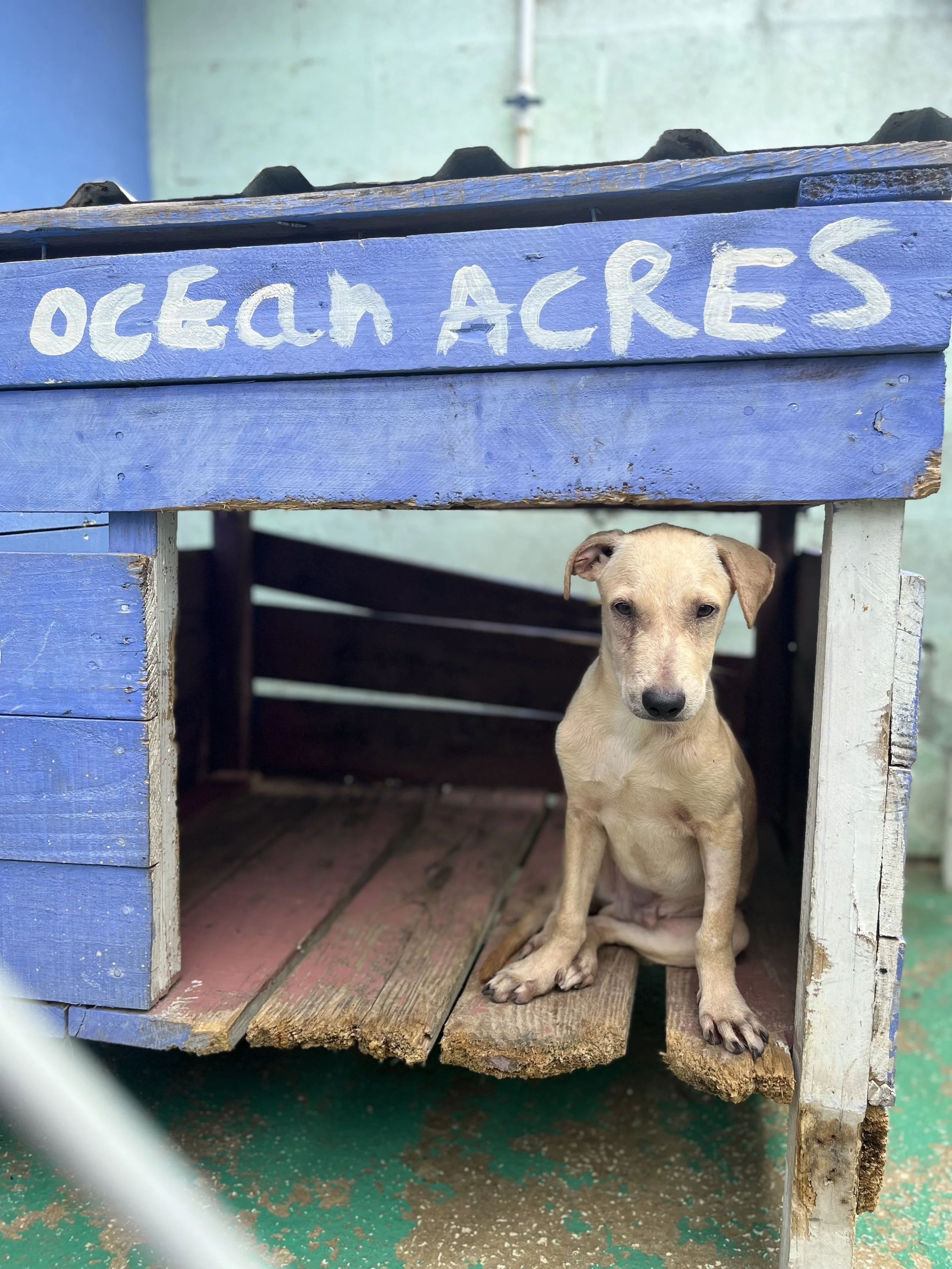
All 160 or so dogs at Ocean Acres Animal Sanctuary live outside, with some cover from the sun and rain. They are mostly ex street dogs and dogs who have been acquired simply to use as a deterrant against burglars. They have often lived on the end of a chain their whole lives and had little human interaction or kindness. And yet these dogs are expected to settle into a human’s home and adapt to life inside and on a lead, once they are adopted. My job is to get them used to going in a crate (for many of them will travel overseas), and walking on a lead. I have to desensitise them to cars (going in a car and being happy about seeing a car pass by), and make them tolerant about being around people, other dogs and cats.
I have also worked at Many Tears Animal Rescue in Wales. They receive a lot of ex breeding dogs. Pure bred old bitches who have been raised in old farm buildings and tossed aside because they can no longer produce puppies and make their owners money. Many of these ‘farmed’ dogs are terrified of people, as they have been so badly treated. Sometimes its a huge reward just to have made enough progress to be able to sit in their kennel and not have them cower away from you.
The Blue Cross in Oxfordshire is another shelter I have volunteered at. The majority of dogs here have lived with families but are now unwanted. They have been given up due to the owner not being able to cope, financially, physically, or because the dog has behavioural issues.
So different shelters produce dogs with slightly different issues. Then there all the rescue dogs wordwide- from Romania, Thailand, Greece, China to name a few. Some of these countries gather up strays and put them in to kill shelters. If noone adopts or claims the dogs, they are destroyed. These dogs come with their own set of issues. They have had to fend for themselves all their lives. Their survival depends on being able to fight or flee. It is ingrained into their psyches. Ex street dogs may always be fearful or aggressive, and often their behaviour will never be totally eradicated. It can be improved upon and managed with a lot of dedication, but not always eradicated. Your fearful rescue dog will probably always be a bit fearful and jumpy and your aggressive rescue dog will probably always have aggression etched into his being, as a back up plan and means to survival.
If you take on a rescue dog you need to be devoted to the cause of training and trust building.
GIVING LOVE IS NOT ENOUGH. I cannot stress this enough.
In fact giving too much love and affection, without leadership, is detrimental to the dog and to your relationship with it.
As a behaviourist, I see dogs at both ends of the line: in the shelters, and in the homes they are adapting to. I see the huge leap they make from one unknown into another unknown, even more alien than the first. Dogs are incredibly adaptable, but in our excitement to ‘rescue’ a dog, to save it from perils, give it love and make ourselves a hero, we forget that this takes TIME. Trust takes time to build. Sometimes years. Giving that time takes patience.
Helping Your Dog Settle In
The first thing I will say is BE PATIENT WITH YOUR NEW RESCUE DOG
Give them time and space to acclimatise. They may not want to approach you for days or even weeks. That’s fine. You should always be aiming at creating forward movement in them, not making them back away from you. Throw them a treat then walk away. Leave them wanting more of you. Trust takes time to build.
Do not smother them with affection
As much as you might want to caress your new dog, be sensitive to their needs. If they do not approach you, they do not want to be touched. When they are ready to approach you, do not put a hand over or on their head as this can be seen as a threatening gesture. Put a hand below their chin and stroke upwards (a high head makes a dog feel proud and good about themselves)
Take introductions slowly
Whether its new people, new pets or even a new room of the house, go gradually and always supervise. Do not overwhelm.
Set clear rules and boundaries
Dogs thrive on structure and consistency. Establish house rules early on and make sure the whole household follow through with them. Dogs without rules are ‘unruly’, and can feel insecure. Simple rules could include ‘no going upstairs’ or ‘sit before food’. You may have to teach a sit first!
Lead with calm assertive energy
Dogs look to their humans for guidance. Calm confident leadership makes them feel safe and secure. Avoid shouting or overexcited energy. Don’t let them make too may decisions- they’ll often make the wrong ones.
Establish a predictable routine
Regular feeding time, walks and rest periods help dogs understand what to expect and builds confidence.
Reward good behaviour Use positive reinforcement- praise, treats and affection- to encourage desired behaviours and strengthen your bond.
If Things Don’t Work Out
Every dog has a different temperament and different issues. Some of these characteristics may not show themselves immediately. A dog that was friendly to you in its safe shelter environment, might become withdrawn, perhaps even aggressive once you have brought it home, if not treated with respect and given space. In time, you may find you have taken on more than you can chew. That’s OK. If you have asked a behaviourist for advice, and given it your best shot, and its still not working out, then there is no shame in returning it to the shelter. The dog’s wellbeing must be your main priority, and if you feel you cannot give the dog what it needs, maybe someone else should be given the chance to.
Although it is admirable to adopt a dog sight unseen (say from abroad), I would encourage against this. Especially if you have another resident dog. You are basically taking pot luck that you will gel and that the dogs will get on. And if you don’t, the rescue dog will end up in another shelter in another country.
My Story
I adopted a Romanian rescue some years ago. He was shy and gentle at first, but as he began to settle in and feel at home, he felt he needed to protect his territory. This is what he would have done on the streets of Bucharest where he grew up as a stray. Every day would have been a life or death scenario, and he would have had to defend himself in order to survive. He started to bark and growl aggressively at male visitors to the house. “I can deal with this”, I thought, “ I’m a behaviourist. He’s found the right owner”. I worked on his confidence and his fear aggression for a year. I taught him tolerance and tricks and broadened his world. We went on busses and trains, he got used to traffic, but he was always jumpy around loud noises.
Then came Guy Fawkes Night. We live in london, and there is no escaping the nightly barrage of noise from outside at this time of year. The quietest room in the house was a windowless junk room in the basement. We would retreat down there with music to try and mask the noise, an dI would try and get him to focus on other things. But the fireworks would go off as soon as it got dark around 4.30pm and continued til around 11pm. For two weeks. There’s only so long you can stay in a windowless room in the basement.
After firework season, his nerves were shot. At the sight of failing light he would retreat to the basement anticipating noise, even though the fireworks were long gone. His aggression towards men worsened and now grew to include some women and small children. He was unhappy. I was unhappy.
I felt I had failed as an owner and as a behaviourist. I rang the shelter I bought him from and explained the problem. I asked them to look out for a new owner for him. I was very particular. Must be one owner, not many visitors, living in countryside etc etc. I would hold onto him until they found the right person. The shelter were amazing and offered to take him back immediatley so he didn’t have to suffer any more. They would keep him as a resident dog. He had been very happy there with his dog friends and a single field to walk in. That’s all he needed.
I had tried to do too much with him, too soon, and in the wrong place. But he taught me a huge amount, and I have grown from the experience. Giving a dog up is not giving up on a dog. Giving a dog up for a better life, as much as it pains you, might just be the thing the dog needs to live a fulfilled life.
Need any help?