
How to Stop Dog to Dog Aggression: A Practical Guide for Owners
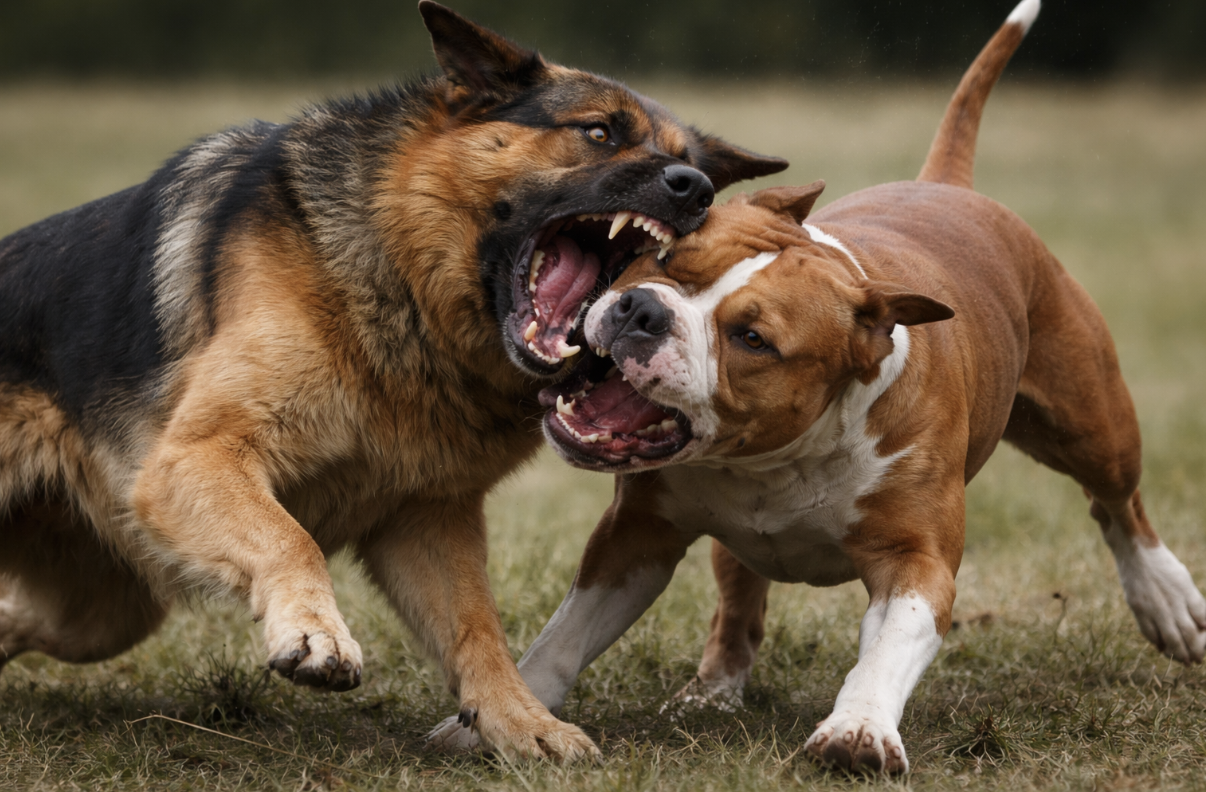
Anyone with an aggressive or reactive dog knows how utterly exhausting and stressful it can be. You may be walking very early or very late in the day when noone else is out, or in remote areas, in a bid to avoid any conflict. (Although avoidance is a sensible option, it will not change your dog’s behaviour when you do come across another dog.)
Rather than avoiding conflict by avoiding all dogs, I teach dogs to think differently about other dogs. I would like to give dog owners some knowledge on what steps they can make to change their dog’s mental thought process when they see another dog, so changing their dog’s psyche for the long term. This is called counter conditioning. The theory is, that instead of your dog seeing another dog and thinking ‘kill’, he will see another dog and think ‘treat’.
The topic of dog aggression is vast, and there are books soley on this one subject. I cannot go into detail in this short blog, but what I aim to do is to bring you hope. Aggression in some dogs can be eradicated, while in others it can only be improved upon and managed. Every dog is different. No dog is a lost cause.
Before I go through the steps to counter condition your dog, lets look at why he might be aggressive in the first place.
Reasons your dog could be reactive
If we know why our dogs are reactive we are one step closer to understanding them and helping them.
In play. Its perfectly normal for a dog to growl while its playing. However, if the play gets too stimulating, the arousal can tip into aggression. Step in, calm the play right down, or remove your dog altogether.
Pain or illness. If your dog has recently started to be aggressive he may be in pain. The growling or air snapping is just a warning sign to other dogs to keep away. The reason could be a pulled muscle, a stomach upset, a wound. Has he started licking an area a lot, refusing walks or food? Get the dog to a vet to be checked over.
Fear. A dog who feels threatened or afraid will growl to keep the threat away. It may be accompanied by a tucked tail, ears back, and backwards movement (maybe after a few steps forward.) Perhaps he has had a past bad experience with another dog which has made him wary. Perhaps he just lacks confidence. (It may be genetic.) Encourage your dog and praise him when accomplishing something new. Never let him fail. Do not try and soothe a fearful growling dog. You will effectively be telling him its ok to be in that fearful state of mind.
Possessiveness (resource guarding). Dogs will growl if they think another dog is going to take away something that they think belongs to them. Body language will be stiff. They may freeze or hover over their prize as they give direct eye contact. A house with more than one dog may experience one dog guarding their possessions or their territory from the other. It could be food, a toy, a water bowl, a sleeping area, the sofa, the garden, another dog or person. In this situation you will need a behaviourist to help guide you in how to set up some rules and boundaries . Also read my blog on resource guarding titled ‘Why Has My Dog Started Growling at Me?’
Learned behaviour. This is particularly common in rescue dogs and ex street dogs. Puppies will have watched their mothers fight off another dog who threatens her family. A street dog will fight another dog for food. Their very survival depends on them being able to eat, and they will do whatever it takes in order to survive. In very rare cases a rescue (especially the bull breeds) may have been trained to fight other dogs for sport. Kill or be killed.
Generally, dogs do not go out looking for a fight! They are not evil. They are simply reacting to any single given moment, as and when it happens. There is nothing predictive about it. The majority of dog to dog aggression cases i see are fear related. For whatever reason, our dog (A) views another dog (B) as a threat. In the past dog A has barked and growled and lunged at dog B, and it has made the other dog go away. (More likely because the owner of the other dog B whisks it away promptly.) So guess what our fearful dog has learned? That barking and lunging works! So in future whatever he is unsure of, he will use the exact same tactic. And so it goes on and gets worse.
We have to show dog A that other dogs are actually ok, and if you stick around them, you may even get rewarded.
How to train your dog to be non reactive. Click to calm.
There are many methods you could use. I am going to outline one very successful one.
I am going to suggest the use of a clicker for this method.. Its not essential, and often awkward as its something else to carry. Instead of clicking, you can simply say ‘Yes’. Please note that if you are the type that talks to your dog all the time, saying ‘yes’ may not be as effective as a clicker, which is a new and different sound to what he is used to . It is a neutral sound that betrays no anger , frustration or anxiety from the handler.
Start by letting him know what the clicker means. Begin inside. Click and reward. Click and reward. Click and reward. After every sound of the clicker comes a tasty treat. No need to say anything.
Now take it into the garden or somewhere outside where there is very little distraction. Click and reward. Now wait for the dog to get a little interested in a sight or smell. (Perhaps he is sniffing the ground or is looking at a bird hopping around. Nothing too stimulating.) He now knows what the click means , so when you click, he should stop what he is doing and turn to you in anticipation of a treat. You may have to up the value of the treats now you are outside. (Try chicken or cheese.)
Now walk down the street with him on a lead. Click, he looks at you, reward.
Now you are going to click when he sees a dog at a distance. The dog should be too far away for him to react to. Every time you see a dog, you are going to click. This should turn his head to focus on you, instead of the other dog, then you are going to reward. Its really important he sees the other dog and you click before any reaction. He is slowly learning that other dogs mean treats.
If, however, your dog is pushed over his threshold, and gets too close to the other dog and barks/lunges, do not click and reward. Instead disagree with it and give a short tug on the lead and then create some distance. After he has calmed down, if its possible and the dog he reacted to is still around, go and seek him out, but keep your distance. Click and reward for not reacting.
The reason i say go seek out the dog he reacted to, is that I want him to learn that something he thought of as a threat, is actually no threat at all. He then leaves with new positive neural pathways being formed. Not all encounters will go smoothly. Don’t worry. Just go back a step to when your dog got it right. It probably means you have tried to do a little too much too soon. And as for off lead dogs who come running up to you- that is the challenge of all challenges. Ask their owner to recall their dog, or walk away.
Fine tuning
After you have clicked and rewarded, you may find that your dog snatches the treat and then goes straight back to staring down the other dog again. To prevent this, allow a few seconds to pass between the click and the reward. Rustle around in your treat bag for a bit. You will have your dog’s full attention. Alternatively put the treat on the ground, followed by another and then another, or you could scatter a few treats on to the grass (in the opposite direction to where the other dog is) for him to sniff out. Sniffing has a calming effect. It also gives him something else to focus on. Turning his back on the other dog and lowering his head are submissive gestures which will make it much less likely for the other dog to retaliate.
After some days or weeks, depending on how well your dog is doing, you can progress to getting a little nearer other dogs and doing exactly the same. When your dog has noticed the other dog, click and reward. You can continue to click and reward as you walk past the other dog. You are going to be like a slot machine- keep giving out the prizes.
Never end the walk on failure. Always end on a successful non reaction as this is what he will remember.
Its worth noting that if you are a fun person to be with on a walk, your dog will be less likely to react to another dog as he will be focussed on you. So play games with your dog, do some agility, hide treats, throw a ball etc etc. Your dog will not care so much about the other dog if he is concentrating on you. And be sure to drain lots of energy, mentally and physically so there is less energy left for barking and lunging. Please be aware though, that if your dog is in a state of excitement or arousal, he will be much MORE likely to react, so be sure have calm moments too, especially around other dogs.
Another thing you can do to prevent further reactivity is show your dog that YOU can protect HIM. It shouldn’t be the other way round. This may mean stepping in front of him and body blocking him from another dog, or it may mean simply having him walk at your side and not in front of you. If he is in front, he will be the first one to meet the have to deal with the perceived ‘threat’.
The results
Hopefully, with time, you will find that your dog looks at you for his treat the moment he sees another dog, without you having even used the clicker. This is great news and means you have done the training beautifully. You have counter conditioned your dog to ignore other dogs, through positive reinforcement. You have taught him to trust you. He knows nothing bad will happen to him.
There may be the occasional reaction when your dog is pushed over his coping threshold, but now you have the tools, you know what to do. And of all else fails, get in touch with me.
See my instagram bemoredog.guru for similar posts to the below:
Need any help?